
Do you really get your own pet's ashes back?
This is the question people ask quietly, usually after they have already paid. It deserves a direct answer rather than a reassurance.
The answer is: it depends entirely on which service you bought, and the two options are usually not explained clearly enough at the counter.
Communal versus individual cremation
Communal means your animal is cremated together with others and nothing is returned. It is cheaper, and it is what a lot of people unknowingly buy when a vet quotes "cremation" as a single line item.
Individual means one animal at a time, and ashes are returned. This costs more because the chamber is loaded once instead of filled.
If you were quoted one price and never asked which of these it was, it is worth finding out. Not because anything was necessarily done wrong — because "ashes back" and "ashes not back" are different products at different prices, and you should know which one you bought.
Does mixing actually happen?
Yes, and it is not a myth. The failure modes are mundane rather than sinister:
- Shared chambers. A facility that runs several individual cremations in one load and then divides the ash cannot guarantee which portion came from which animal.
- Incomplete recovery. Ash remains in the chamber and in the cremulator. A facility that does not clean between runs carries a little of the previous animal forward.
- Label errors. Simple human error at a busy facility, and the hardest to detect afterwards.
None of these are universal. Plenty of crematoriums are careful and can prove their process. The point is that the difference is invisible to you unless you ask.
Four questions that settle it before you pay
- "Is this individual or communal?" Ask for the word, not a description. If the answer is vague, treat it as communal.
- "Can I witness it?" A facility that allows witnessing has nothing to hide. Many will not allow it, which is not automatically a red flag — but the ones that do are telling you something.
- "What is the return weight?" Ashes come back as a specific weight relative to the animal. A crematorium that can tell you the expected range is a crematorium that weighs.
- "How is it identified?" Look for a numbered tag that goes in with the animal and comes back with the ashes. This is the single cheapest safeguard and the easiest to ask about.
What most people actually do with the ashes
Surveys of grieving owners consistently show the same three answers, in roughly this order:
Keep them at home. The most common by a wide margin. On a shelf, in a cupboard, in a box that is not opened for years. There is no rule against this, and the idea that it is morbid is largely cultural.
Scatter or bury them. Somewhere that meant something — a garden, a favourite walk, a family plot. Worth checking local rules first: scattering in public parks and waterways is restricted in many places, and burying in a rented garden is sometimes prohibited.
Turn them into something. Jewellery, glass, a tattoo additive, a tree. This is where the industry gets expensive, and where the honest advice is to wait. Almost everyone who regrets a decision regrets making it in the first month.
If you already have an urn and you are not sure
You cannot test ashes at home. What you can do is ask the facility for the record: the date, the service type, the tag number, the weight returned. A reputable one keeps these and will send them. A refusal to produce a record is itself the answer.
One thing worth saying plainly
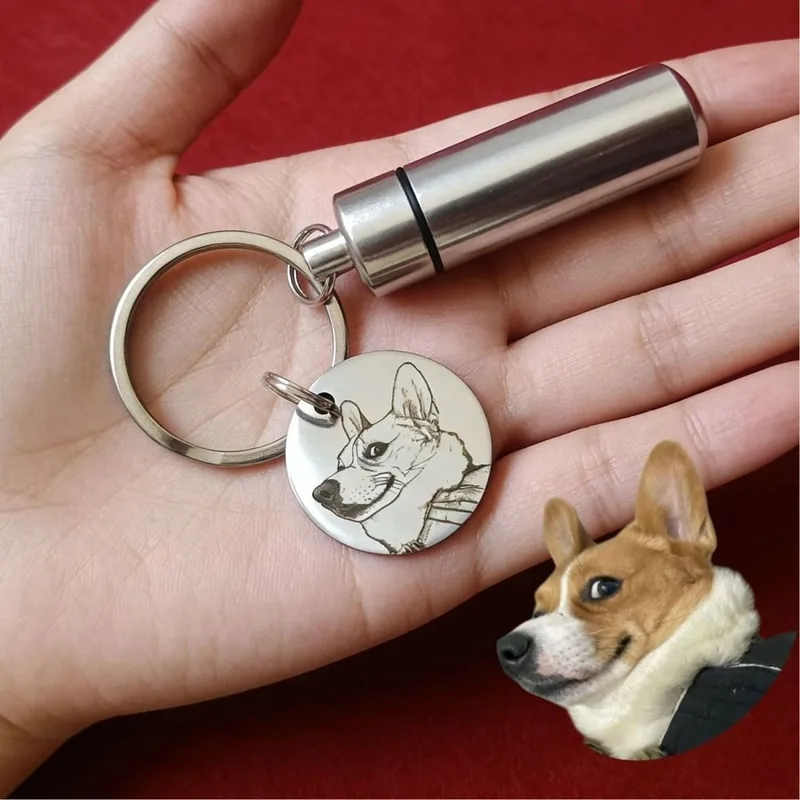
We do not make anything that holds ashes. Our pieces hold a photograph, a name, or a clipping of fur — nothing that requires you to send remains through the post. That is a deliberate limit, and it means we have no reason to talk you into an urn. If you are deciding between cremation services, the four questions above are the ones that matter, and they cost nothing to ask.